지훈 has recently been enjoying a single-player card game.
Each card used in the game has one positive integer written on it, and several cards may have the same number.
To start, shuffle an even number of cards randomly and split them into two piles of equal size, placing one on the left and the other on the right.
Also prepare an empty bin.
Now play by comparing the top cards of the two piles.
The rules are as follows. From now on, call the top card of the left pile the left card and the top card of the right pile the right card.
(1) At any time, you may discard only the left card into the bin, or discard both the left and right cards. This earns no points.
(2) If the number on the right card is smaller than the number on the left card, you may also discard only the right card.
When discarding only the right card, you earn points equal to its number.
(3) Continue under rules (1) and (2). If either pile has no cards remaining, the game ends,
and the total points earned up to then are the final score.
The following example starts with two piles of three cards each.
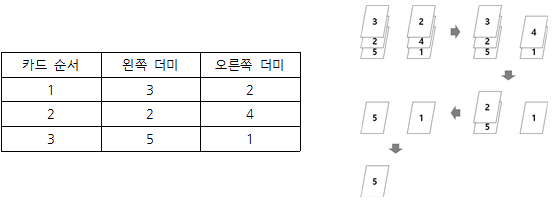
Here, the right card, 2, is initially smaller than the left card, 3,
so under rule (1), you may discard only the left card or both cards,
or under rule (2), discard only the right card.
If you choose to discard only the right card, you earn 2 points and discard that card, 2.
The new top card on the right is 4, which is greater than the left card, 3,
so under rule (1), you may discard only the left card or both cards.
If you discard both cards, the left card becomes 2 and the right card becomes 1.
Again, rules (1) and (2) offer three choices;
if you choose to discard only the left card, the left card becomes 5 and the right card remains 1.
Rules (1) and (2) again offer three choices;
if you discard only the right card, you earn 1 point and discard the right card, 1.
The right pile is now empty, so the game ends under rule (3), with a final score of $2+1=3$.
Given the two piles, write a program that outputs the maximum final score obtainable in the game.
The maximum final score in the example above is 7.
Input
The first line of standard input contains a positive integer $N$ ($1\le N\le2{,}000$), the number of cards in each pile.
The next line contains the $N$ integers $A$ ($1\le A\le2{,}000$) on the left-pile cards, in card order.
The following line contains the $N$ integers $B$ ($1\le B\le2{,}000$) on the right-pile cards, in card order.
Each pile may contain two or more cards with the same number.
Output
Output the maximum obtainable final score to standard output.
Examples
Input 1
3
3 2 5
2 4 1
Output 1
7
Input 2
4
1 2 3 4
4 1 2 3
Output 2
6
Subtasks
31 points: $N\le10$.
33 points: $N\le25$.
36 points: No additional constraints.