The village of KOI has $N$ houses on a two-dimensional plane. House $i$ is located at $(X_i,Y_i)$.
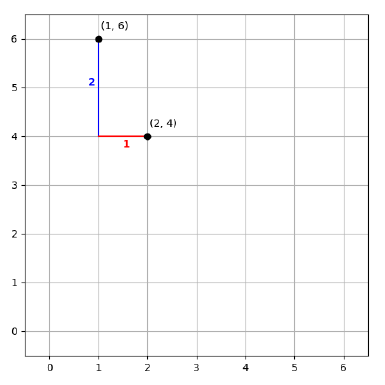
The distance between houses $i$ and $j$ is $|X_i-X_j|+|Y_i-Y_j|$, the sum of the differences in their $X$ and $Y$ coordinates. For example, the houses at $(1,6)$ and $(2,4)$ are $(2-1)+(6-4)=3$ units apart.
KOI plans to install shelters in $K$ houses so that residents can evacuate safely during a disaster. To protect everyone, choose the $K$ houses so as to minimize the greatest distance from a house to its nearest shelter, and find that greatest distance.
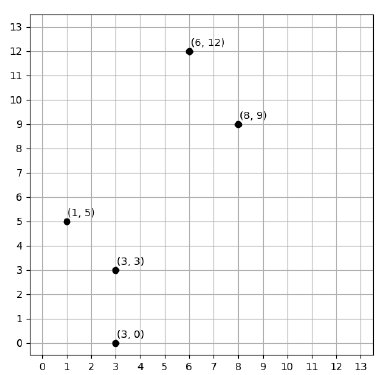
The figure below shows a village with $5$ houses at $(1,5),(3,0),(3,3),(6,12),(8,9)$.
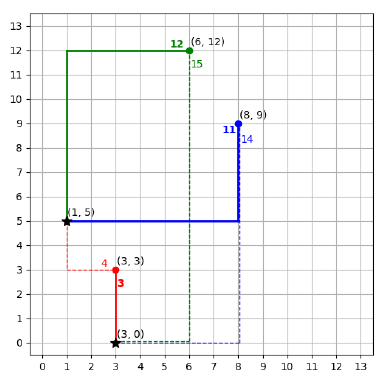
Suppose we want to install $2$ shelters. If we place them in the houses at $(3,0)$ and $(1,5)$, the distances from the other three houses to their nearest shelters are $3,11,12$, respectively; the greatest is $12$.
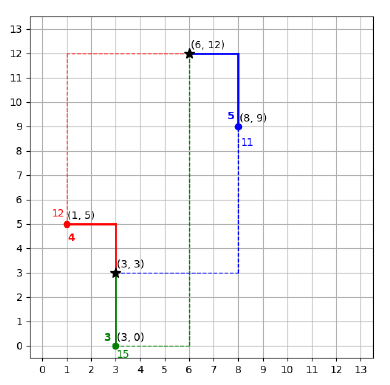
However, if we place shelters at $(3,3)$ and $(6,12)$, the house farthest from its nearest shelter is $(8,9)$, at distance $5$ from $(6,12)$. No placement makes the maximum distance less than $5$, so the desired distance is $5$.
Given the house locations in KOI and the number of shelters to install, find the smallest possible value of the greatest distance from a house to its nearest shelter over all shelter placements.
Constraints
- All given numbers are integers.
- $1 \le K \le 3$
- $K \le N \le 50$
- $0 \le X_i \le 100\,000$
- $0 \le Y_i \le 100\,000$
- No two houses share a location; that is, $(X_1,Y_1),(X_2,Y_2),\ldots,(X_N,Y_N)$ are distinct.
Subtasks
- ($5$ points) $N=K+1$
- ($7$ points) $K=1$, for every $i$ ($1 \le i \le N$), $X_i=i$ and $Y_i=0$.
- ($10$ points) $K=1$
- ($18$ points) $K=2$
- ($35$ points) $K=3$, for $1 \le i \le N-1$, $X_i<X_{i+1}$, and for every $i$ ($1 \le i \le N$), $Y_i=0$. Thus, $X$ is sorted in ascending order.
- ($25$ points) $K=3$
Input
The first line contains $N$ and $K$, separated by a space.
The next $N$ lines give the house locations: the $i$-th line ($1 \le i \le N$) contains $X_i$ and $Y_i$, separated by a space.
Output
Print the answer on the first line.
Examples
Input 1
5 2
1 5
3 0
3 3
6 12
8 9
Output 1
5
Input 2
4 2
0 0
0 5
5 0
5 5
Output 2
5
Input 3
4 1
1 0
2 0
3 0
4 0
Output 3
2
Input 4
2 1
20 23
5 14
Output 4
24