Problem Statement
There are many cards, each with an integer from $1$ to $1000$ written on it. Anna and Bruno play the following game using those cards.
Anna has a pile consisting of $A$ cards, and Bruno has a pile consisting of $B$ cards. Anna discards any number of cards ($0$ cards is also allowed) from her $A$ cards to make a new pile. Bruno discards some number of cards ($0$ cards is also allowed) from the top and some number of cards ($0$ cards is also allowed) from the bottom of his pile consisting of $B$ cards to make a new pile. However, the remaining cards are not reordered when discarding. If the $2$ piles made in this way match, the number of cards contained in one of the piles becomes the score of the $2$ players. Here, $2$ piles match if the number of cards $n$ contained in each pile is the same, and for every $i$-th card from the top ($1 \le i \le n$), the integers written on the cards are all the same.
For example, suppose Anna has a pile of $5$ cards with the integers $1, 2, 3, 4, 5$ written on them in order from the top, and Bruno has a pile of $4$ cards with the integers $3, 1, 4, 1$ written on them in order from the top. At this time, if Anna discards the cards $2, 3, 5$, and Bruno discards the top card $3$ and the bottom card $1$, the piles of the $2$ players match. At this time, since the number of cards contained in one of the remaining piles is $2$, the $2$ players get a score of $2$.
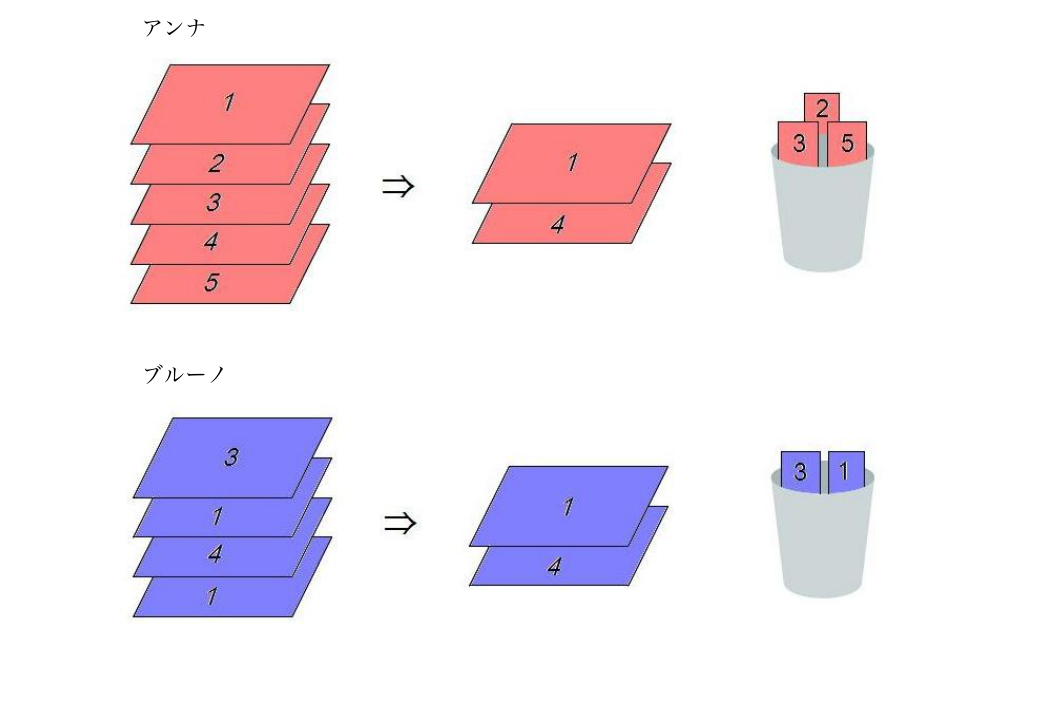
We want to find the maximum value of the score of the $2$ players.
Task
Given information about the piles of cards held by Anna and Bruno, write a program to find the maximum value of the score of the $2$ players.
Limits
- $1 \le A \le 5000$: The number of cards in Anna's pile.
- $1 \le B \le 5000$: The number of cards in Bruno's pile.
- The integers written on the cards are between $1$ and $1000$, inclusive.
Input
Read the following data from standard input.
- On the $1$-st line, the integers $A, B$ are written, separated by a space.
- On the $2$-nd line, $A$ integers are written, separated by spaces; the $i$-th integer ($1 \le i \le A$) represents the integer written on the $i$-th card from the top of Anna's pile.
- On the $3$-rd line, $B$ integers are written, separated by spaces; the $j$-th integer ($1 \le j \le B$) represents the integer written on the $j$-th card from the top of Bruno's pile.
Output
Output to standard output on $1$ line an integer representing the maximum value of the score of the $2$ players.
Subtasks
- For $10\%$ of the points in the grading data, $A \le 10, B \le 10$ are satisfied.
- For $50\%$ of the points in the grading data, $A \le 100, B \le 100$ are satisfied.
Sample 1
Input
5 4
1 2 3 4 5
3 1 4 1
Output
2
This sample corresponds to the example in the problem statement.
Sample 2
Input
6 5
4 1 5 2 3 4
4 5 4 2 3
Output
3
In this sample, there are $2$ ways for the $2$ players to get a score of $3$.
- When Anna discards the cards $1, 2, 3$ and Bruno discards the cards $2, 3$, the piles of the $2$ players become $4, 5, 4$ in order from the top, and the score of the $2$ players is $3$ points.
- Also, when Anna discards the cards $1, 5, 4$ and Bruno discards the top cards $4$ and $5$, the piles of the $2$ players become $4, 2, 3$ in order from the top, and the score of the $2$ players is $3$ points.