To the west of the Australian continent lies the vast Indian Ocean. Mr. JOI, a marine researcher, is studying the characteristics of $N$ kinds of fish inhabiting the Indian Ocean.
For each kind of fish, a rectangular cuboid habitat is defined in the sea. Fish can move to any location within their habitat, including the boundary, but they never go outside their habitat. A point in the sea is represented by $3$ real numbers $(x, y, d)$: $(x, y, d)$ represents a point at a depth of $d$ from the sea surface, located at a position advanced $x$ to the east and $y$ to the north relative to a certain reference point when viewed from the sky. Here, the sea surface is assumed to be a plane.
Mr. JOI wants to know the extent of locations where the habitats of $K$ or more kinds of fish overlap. Write a program to find the total volume of all such locations.
Input
The input consists of $1 + N$ lines.
Line $1$ contains $2$ integers $N, K$ ($1 \le K \le N \le 50$) separated by a space. This represents that there are $N$ kinds of fish, and we want to find the volume of locations where the habitats of $K$ or more kinds of fish overlap.
The $i$-th line ($1 \le i \le N$) of the following $N$ lines contains $6$ integers $X_{i,1}, Y_{i,1}, D_{i,1}, X_{i,2}, Y_{i,2}, D_{i,2}$ ($0 \le X_{i,1} < X_{i,2} \le 1000000 \ (= 10^6)$, $0 \le Y_{i,1} < Y_{i,2} \le 1000000 \ (= 10^6)$, $0 \le D_{i,1} < D_{i,2} \le 1000000 \ (= 10^6)$). This represents that the habitat of the $i$-th kind of fish is a rectangular cuboid having the $8$ points $(X_{i,1}, Y_{i,1}, D_{i,1})$, $(X_{i,2}, Y_{i,1}, D_{i,1})$, $(X_{i,2}, Y_{i,2}, D_{i,1})$, $(X_{i,1}, Y_{i,2}, D_{i,1})$, $(X_{i,1}, Y_{i,1}, D_{i,2})$, $(X_{i,2}, Y_{i,1}, D_{i,2})$, $(X_{i,2}, Y_{i,2}, D_{i,2})$, $(X_{i,1}, Y_{i,2}, D_{i,2})$ as its vertices.
Output
Output in $1$ line the total volume of the locations where the habitats of $K$ or more kinds of fish overlap.
Examples
Input 1
3 2
30 50 0 50 70 100
10 20 20 70 90 60
40 60 20 90 90 70
Output 1
49000
Note
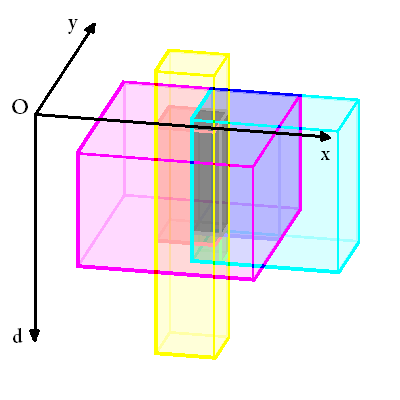
In Sample 1, for example, the point $(45, 65, 65)$ is within the habitats of the $1$-st kind of fish and the $3$-rd kind of fish, so it is a location that satisfies the condition. On the other hand, the point $(25, 35, 45)$ is within the habitat of only the $2$-nd kind of fish, so it is not a location that satisfies the condition. Also, the habitats of the fish are as shown in the figure below. Point $O$ represents the reference point on the sea surface.
Input 2
1 1
0 0 0 1000000 1000000 1000000
Output 2
1000000000000000000