There are $N$ cities and $M$ bidirectional roads. The cities are numbered $1$ through $N$, and the roads are numbered $1$ through $M$. The road $i$ connects cities $A_i$ and $B_i$, and its length is $2^i$. It is guaranteed that you can reach from any city to any city using these roads.
Snuke wants to go driving. He wants to start from city $1$, pass through each road at least once, and return to city $1$. Compute the shortest possible length of his route, modulo $10^9 + 7$.
Input
$$ \begin{gathered} N\ M\\ A_1\ B_1\\ \vdots\\ A_M\ B_M \end{gathered} $$
- $2 \le N \le 400000$
- $1 \le M \le 500000$
- $1 \le A_i, B_i \le N$
- $A_i \ne B_i$
- It is possible to reach from any city to any city using roads.
- No two roads connect the same pair of cities.
Output
Print the shortest possible length of Snuke’s route, modulo $10^9 + 7$.
Examples
Input 1
4 5
1 2
3 4
2 3
1 3
2 4
Output 1
70
Input 2
6 10
4 6
4 5
3 6
5 2
3 2
1 2
3 4
6 1
2 4
1 3
Output 2
2132
Note
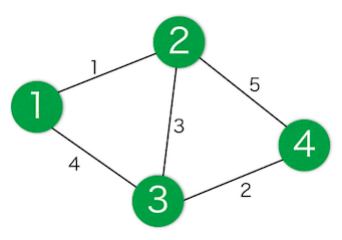
For example, in sample 1 one optimal route is $1 \to 2 \to 3 \to 4 \to 2 \to 3 \to 1$.