Problem
The JOI Highway runs straight east and west, and there are $n$ post towns along the JOI Highway. The post towns are numbered $1, 2, \dots, n$ in order from west to east. Post town $1$ is the westernmost post town, and post town $n$ is the easternmost post town.
Mr. JOI departs from post town $1$ on an $m$-day journey. He decides his travel itinerary according to a sequence $a_1, a_2, \dots, a_m$. Here, $a_i$ is a non-zero integer representing the movement method on day $i$. Specifically, if Mr. JOI departs from post town $k$ on day $i$, he moves straight from post town $k$ to post town $k + a_i$ within day $i$.
Given the number of post towns $n$, the number of travel days $m$, the information about the distances between adjacent post towns, and the sequence $a_1, a_2, \dots, a_m$ representing the movement methods, write a program to find the remainder when Mr. JOI's total travel distance over the $m$-day journey is divided by $100000 = 10^5$.
Input
Read the input from the file input.txt.
On line $1$ of the input, two integers $n, m$ ($2 \le n \le 100000 = 10^5$, $1 \le m \le 100000 = 10^5$) separated by a space are written, representing the number of post towns $n$ and the number of travel days $m$.
On the following $n - 1$ lines, the distances between adjacent post towns are written. On line $i + 1$ ($1 \le i \le n - 1$), a positive integer $s_i$ ($1 \le s_i \le 100$) representing the distance between post town $i$ and post town $i + 1$ is written.
On the following $m$ lines, the information about the movement methods is written. On line $i + n$ ($1 \le i \le m$), a non-zero integer $a_i$ representing the movement method on day $i$ is written. There is never a movement going west of post town $1$ or going east of post town $n$.
In $50\%$ of the scoring data, $n \le 100$ and $m \le 100$ hold.
Output
Output to the file output.txt.
The output consists of $1$ line containing the remainder when Mr. JOI's total travel distance over the $m$-day journey is divided by $100000 = 10^5$.
Sample 1
Input
7 5
2
1
1
3
2
1
2
-1
3
2
-3
Output
18
Explanation
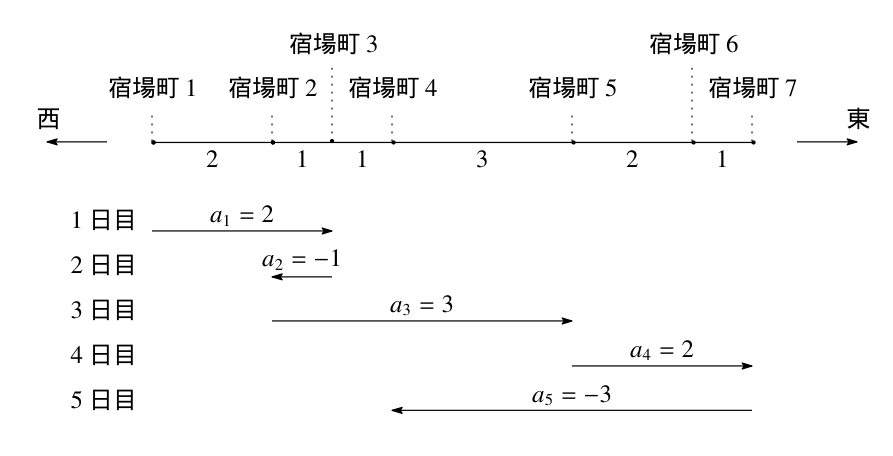
On day $1$, he moves from post town $1$ to post town $3$. On day $2$, he moves from post town $3$ to post town $2$. On day $3$, he moves from post town $2$ to post town $5$. On day $4$, he moves from post town $5$ to post town $7$. On day $5$, he moves from post town $7$ to post town $4$. The total travel distance over the $5$-day journey is $18$.