Problem Statement
In JOI Kingdom, there are $N$ towns, and they are connected by $M$ bidirectional roads. There are shopping malls in $K$ towns, and the citizens travel along the roads to one of those towns to go shopping.
Depending on the location of a house, it may be necessary to travel a long distance to go shopping, which is very inconvenient. To grasp this actual situation, the King decided to investigate how long the shortest distance to a town with a shopping mall can be depending on the location of a house. Since a house may be built in the middle of a road (see the explanation for Sample $1$), this investigation is very difficult. Therefore, the King has asked you, an excellent programmer, to write a program that performs the investigation.
Given the information of the roads and the information of the towns with shopping malls, write a program to find the distance from the towns with shopping malls to the farthest point on a road (including endpoints). You may ignore the distance required to move within a town.
Input
Read the following input from Standard Input:
- The $1$-st line contains the integers $N, M, K$ separated by spaces. $N$ represents the number of towns in JOI Kingdom, $M$ represents the number of roads in JOI Kingdom, and $K$ represents the number of towns with shopping malls, respectively. The towns are numbered $1, 2, \dots, N$.
- The following $M$ lines represent the information of the roads. The $(i + 1)$-th line ($1 \le i \le M$) contains the integers $a_i, b_i, l_i$ ($1 \le a_i \le N, 1 \le b_i \le N, 1 \le l_i \le 1000$) separated by spaces. This means that the $i$-th road connects town $a_i$ and town $b_i$, and has length $l_i$. Both ends of a road are never the same town. Also, for any $2$ towns $p, q$, there are never $2$ or more roads connecting $p$ and $q$. It is possible to travel from any town to any town by following some roads.
- The following $K$ lines represent the information of the shopping malls. The $(i + M + 1)$-th line ($1 \le i \le K$) contains $1$ integer $s_i$ ($1 \le s_i \le N$). This means that there is a shopping mall in town $s_i$. The same value never appears $2$ or more times among $s_1, \dots, s_K$.
Output
Output $1$ integer to Standard Output: the maximum shortest distance to a town with a shopping mall, rounded to the nearest integer (with halves rounded up).
Sample
Sample 1
Input
3 3 1
1 2 1
2 3 1
3 1 1
1
Output
2
Explanation
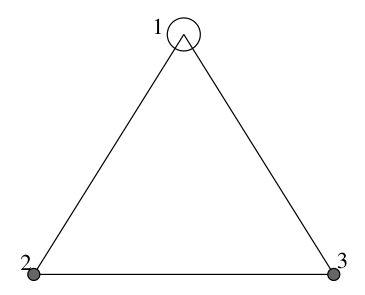
Sample $1$ represents the towns shown in the figure below. The lengths of the roads are all $1$. There is a shopping mall only in town $1$.
The point farthest from a town with a shopping mall is the point on the road connecting town $2$ and town $3$ at a distance of $0.5$ from town $2$, and its distance to the town with a shopping mall is $1.5$. Therefore, output $2$, which is the value rounded to the nearest integer.
Sample 2
Input
4 5 2
1 2 4
1 3 1
2 3 2
2 4 2
3 4 1
2
4
Output
3
Constraints
- $2 \le N \le 3000$: the number of towns in JOI Kingdom.
- $1 \le M \le 100000 = 10^5$: the number of roads in JOI Kingdom.
- $1 \le K \le N$: the number of towns with a shopping mall.
- $1 \le l_i \le 1000$: the length of the $i$-th road.
Scoring
- For test cases worth $40\%$ of the total score, $K = 1$ holds.