Long ago, there was a settlement there, and many people lived in it. People built buildings of various shapes and sizes. However, those structures have already been lost, and only historical records and the pillars found in the ruins served as clues to the locations of the structures.
The historical records contain a description of a temple. Seen from above, the temple was an exact square, and there were pillars at its four corners. It is unknown which direction the temple faced. Furthermore, it is unknown whether there were pillars on its edges or inside it. Archaeologists concluded that among the squares formed by the pillars found in the ruins, the one with the maximum area must be the temple.
Since the coordinates of the pillar positions are given, write a program to find the square with the maximum area among the squares that can be formed by $4$ pillars, and output its area. Note that the sides of the square are not necessarily parallel to the coordinate axes.
Example
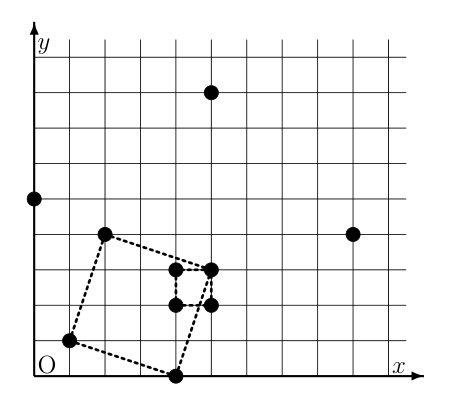
In the example shown in the figure below, there are $10$ pillars, and the $4$ pillars at coordinates $(4, 2), (5, 2), (5, 3), (4, 3)$ and the $4$ pillars at coordinates $(1, 1), (4, 0), (5, 3), (2, 4)$ each form a square. The square with the maximum area is the latter, and its area is $10$.
Input
The $1$-st line contains the number of pillars $n$ found in the ruins.
Each of the $n$ lines from the $2$-nd line to the $n + 1$-th line contains the $x$-coordinate and $y$-coordinate of a pillar, separated by a space.
No $1$ pillar appears $2$ or more times.
$n$ is an integer satisfying $1 \le n \le 3000$, and the $x$-coordinate and $y$-coordinate of each pillar are integers greater than or equal to $0$ and less than or equal to $5000$.
Among the grading test data, $30\%$ of the total score satisfies $1 \le n \le 100$, and $60\%$ of the total score satisfies $1 \le n \le 500$.
Output
Output $1$ integer. If there exists a square formed by $4$ pillars, output the area of the one with the maximum area among such squares; if no such square exists, output $0$.
Sample Input and Output
Sample Input 1
The input and output corresponding to the example are as follows.
10
9 4
4 3
1 1
4 2
2 4
5 8
4 0
5 3
0 5
5 2
Sample Output 1
10